
Gave His Gains Away
Shane took his gains from the market and donated them to a charity that buys goats for families in a hurricane-damaged country. Newsday wrote it up.
A former Morgan Stanley professional teaches your teen to invest for real over six weekends, live on Zoom. Your teen learns how the market works, researches companies the way an analyst does, and places trades in a simulated account they keep, with zero real money at risk. They finish with a Certificate of Achievement and a skill they will use for the rest of their life.
$697, or 2 payments of $367. Classes cap at 30 students.

Annaline Dinkelmann spent ten years at Morgan Stanley and was the Wall Street guide financial journalists turned to during the 2008 crisis. She has taught teenagers to invest for 15 years.

Most parents of high schoolers have looked at their teen's activities and thought it looked fine. A sport, a club, decent grades, maybe a part-time job.
Every other applicant has the exact same list. Since the pandemic, test scores carry less weight, and admissions offices ask a different question now: what did this student actually do?
Parents want one thing that stands out on the application and still matters long after college. Investing is one of the few things that does both.
A sport that ends at graduation
A club that ends at graduation
A summer program ten thousand other students also took
An investing record your teen can explain in an interview, and a skill they keep for fifty years
A teenager who can research a company, read a chart, and explain why they bought what they bought has done something almost no other applicant can claim. Three reasons so few can.
The economics elective, if the school has one, covers supply and demand and stops there.
They hand a 17 year old a trading account in four minutes. They make money when he trades, so trading is what they push, with no education behind it.
So there is no one at home to ask, and most families do not know where to start.
After ten years at Morgan Stanley, Annaline found that teenagers can grasp the stock market. They just cannot be taught like adults. So she translates the way a professional works into a teenager's world.
Research starts at home with the cereal box, the phone, and the car in the driveway. Your teen reads an earnings report like a report card. Every class is live, hands-on, and small, with games and brain breaks built in.
Every student gets a live simulated trading account loaded with virtual cash. They place real trades in real time with zero real money at risk, and they keep the account after the program ends.

Each part ends with something your teen can say out loud, to you, to a college interviewer, or in an essay.
The language of Wall Street, how a company goes public, stocks and bonds, reading a chart, and who the players are.
Start with the companies around them, then read an earnings report and tell a real business from a hype stock.
Know when to buy and when to sell, manage risk, place trades in a simulated account, and track it in a spreadsheet.
The program goes on the activity list. The project they build becomes the essay, and the optional Teen Investor Cup can add a competition result.
Most programs teach kids what a stock is. This one teaches them how to research, decide, act, and live with the result.
Each session runs six weekends in a row, and Annaline adds new sessions each season. Your teen picks Saturday or Sunday and a morning or afternoon time, and can change any of it later.
$697 or 2 payments of $367 for any session. Sibling discount available, email annaline@teachmewallstreet.com.
Games get rescheduled. Finals land on a Saturday. A ski weekend shows up on the calendar in January. Parents tell Annaline the schedule worries them more than anything else, so the program bends around it.
Both days and both time slots teach the same class. Your teen moves from Saturday to Sunday, or morning to afternoon, any week. Send one email and Annaline's team moves them.
Annaline records every class. Your teen watches the one they missed and arrives at the next class caught up.
If a sport season or a family trip takes over, your teen moves to a later session, or picks up Part 2 in a later session after finishing Part 1. Their enrollment carries over.
Competitions now carry real weight on college applications. A competition result shows an admissions office what a student did with what they learned.
The Teen Investor Cup is Annaline's international investing competition. Your teen manages a simulated portfolio against students from around the world, with weekly office hours and coaching from Annaline. The Cup teaches strategy: how the Fed, interest rates, and company earnings move the market.
Only students who finish the weekend program can enter, so every competitor starts with the full skill set. A strong result in a serious competition means something to an admissions office.
The weekend program is complete on its own. The Cup is an extra step for teens who want to compete once they finish.
Pick companies, set an entry price, and decide what they can lose before they buy.
Place trades in the competition account and log every decision in their spreadsheet.
Bring the week's decisions to office hours and adjust with Annaline's feedback.
A ranking, a certificate, and a record they can explain in an interview.
A project is something a student starts on their own using what they learned: a fundraiser, a podcast, a campaign, a club. Admissions officers read thousands of activity lists, and a project tells them this student took initiative and finished something. It also gives your teen a real story for the essay and the interview.
The weekend program gives your teen the skill. The project is what they choose to do with it. Here is what three students built after the same class.
Shane took his gains from the market and donated them to a charity that buys goats for families in a hurricane-damaged country. Newsday wrote it up.
Tyler finished the program at 15 and petitioned his state senator to get financial literacy taught in New York public schools. He collected 500 signatures and the senator sponsored the bill. He is at Cornell now.
Anna built Monopoly Money Mastery, a podcast library that teaches kids in her community how to invest using real estate. She got into her first-choice college.
What will your teen's project be?
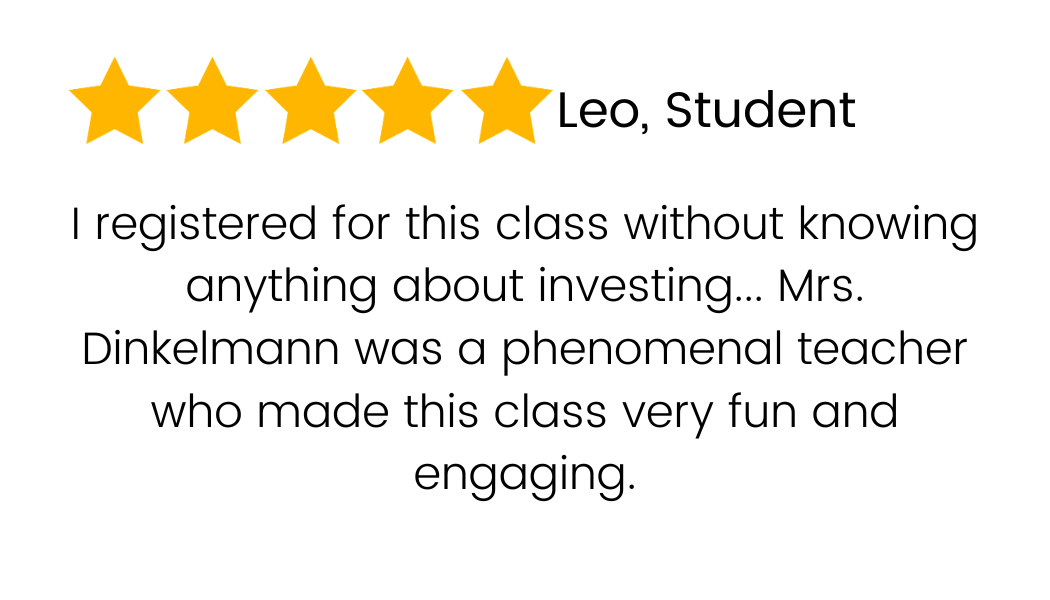
Real emails and reviews from families who took this program, unedited.




If the dates stop working or you change your mind, email up to one week before your teen's first class and Annaline refunds every dollar. No questions asked.
If the school year is already full, the summer program covers the same skill in a longer, deeper format: two weeks of live classes on weekdays, when your teen has room to focus. Teens can split it into two separate weeks if the summer calendar is busy.

I started my career on Wall Street, literally. I spent ten years at Morgan Stanley with an office across the street from the New York Stock Exchange. I traded professionally, and for years I gave walking tours of Wall Street. During the 2008 financial crisis, I was the guide financial journalists turned to when they needed Wall Street explained.
I have taught teenagers to invest for 15 years, online since 2020. The kids are the best students I have ever had. They ask better questions than adults do, and when a 15 year old marks up a stock chart correctly for the first time, you can see it click.
I know how busy high school is, because my students tell me every week. That is why your teen can switch days, catch up from a recording, or move to a later session. I would rather your teen finish than squeeze in.
I do not recommend stocks, and this is not a get rich quick class. I teach teenagers how the market works so they can make their own decisions for the rest of their lives.
Annaline
Your teen can switch to the other day or the other time slot that weekend with one email. If they cannot make either, they watch the recording and join the next class caught up.
Email the team and they will move your teen to a later session. Your teen can also finish Part 1 now and take Part 2 in a later session.
Yes. Part 1, Wall Street 101, starts from the ground up. Most students arrive knowing nothing about the market and leave able to explain how it works.
Annaline built the classes for teenagers. They are live and small, with breakout groups, games, and brain breaks, and students trade in their own account from the first weeks. Parents often write to say their teen asked when the next class starts.
None. All trading happens in a simulated account with virtual cash. Any real account down the road is a family decision.
Yes. Breakout groups are organized by age, and students finishing 8th grade do well here too. Curiosity is the only requirement.
Yes. The program goes on the activity list, the certificate goes in the application file, and the skills give your teen something specific to write about. The optional Teen Investor Cup adds a competition result.
The Cup is an optional add-on, open only to students who finish the weekend program. The weekend program is complete without it. You can add the Cup at checkout or wait until your teen finishes and decide then.
A computer or tablet with Zoom, headphones, a notebook and pen, and their camera on for the full session so the instructors can keep everyone participating.
A maximum of 30 students. Formal instruction happens together, then students break into groups of 8 to 10 per instructor, organized by age.
Yes. Email annaline@teachmewallstreet.com and the team will set up a 10% discount for a second child.
A full refund if you cancel one week or more before your teen's first class.
Did not find your question? Email annaline@teachmewallstreet.com.
Six weekends from now, your teen can read a chart, explain why they bought what they bought, and show you the results. That goes on the application, and the skill stays with them for fifty years.
$697 or 2 payments of $367. Swap dates any time. Full refund up to one week before the first class.
Teach Me Wall Street is an education company founded by Annaline Dinkelmann. Nothing in this program constitutes financial advice or a promise of financial results. All practice trading uses virtual currency in a simulated account.

Get started today before this once in a lifetime opportunity expires.